Best possible weather
December – April
Decide early and the most dependable days of the year are yours.

Riviera Maya · Planning
There is no single best month. There are trade-offs, and this is a map of what you are choosing between.
There is no single best month to visit the Riviera Maya, and any page that gives you one is quietly deciding for you what matters most about your trip.
What actually exists is a set of trade-offs. The months with the most reliable weather are also the ones everyone else has already chosen. The months with the emptiest beaches carry the most rain and the most risk. The shoulder weeks in between are where most people are happiest, and they are the hardest to find advice about.
So this is less a ranking than a map of what you are choosing between.
The Riviera Maya does not have a bad season. It has seasons that suit different travellers. The question is which trade you are willing to make.
Forget spring, summer, autumn and winter: they describe almost nothing useful about this coast. There are two seasons, and they are defined by rain.
The dry season runs roughly from December to April. Long stretches of sun, low humidity by local standards, and the most predictable days you will get. This is also when North America and Europe most want to be here, which is why it is high season.
The rainy season runs from May to November. According to the Mexican national weather service's 1981–2010 climate normals for Quintana Roo, this is the wet half of the year, and September is the wettest month of all, averaging 196.3 mm of rain.
That number deserves context, because "rainy season" misleads people who imagine grey European drizzle. Rain here usually arrives as a heavy afternoon downpour that clears within an hour or two, not as a day lost indoors. You get wet, then it stops, and the light afterwards is often the best of the day.
Rain
Hurricanes
Our pick
Hotter than most people plan for, and the heat peaks before the rain does.
Figures from the Mexican national weather service (SMN) 1981–2010 climate normals for the state of Quintana Roo.
Two caveats worth knowing. These are averages across the whole state, which includes inland areas; the coast runs milder at night and breezier by day. And averages are not forecasts. A 33 °C average maximum means plenty of days above it.
The practical version: if you are heat-sensitive, avoid May through August. If you want to be outdoors at midday rather than hiding from the sun, aim for December through March.
This is the part most villa and hotel pages skip, so here it is plainly.
The Atlantic hurricane season runs from June 1 to November 30. According to the US National Hurricane Center, the climatological peak is September 10, with most activity occurring between mid-August and mid-October.
Should it change your plans? If you have fixed dates in September and no flexibility, go, insure the trip, and keep expectations honest. If you are choosing freely and the idea of weather uncertainty would ruin the trip for you, choose a different month. There are eight good ones.
Sargassum is seasonal too, and it follows a different calendar from the rain, which is why it deserves its own answer rather than a line in a weather guide.
The short version: it is generally heaviest in the spring and summer months and clearest in the winter, it varies enormously from one beach to the next along the same coast, and it is something to plan around rather than a reason to cancel.
We wrote a full month-by-month breakdown of it, including how it differs by beach and what to do if you arrive and find it: sargassum in the Riviera Maya.
Crowds track the dry season almost exactly, with sharp spikes on top.
Peak of the peak is the Christmas and New Year window, plus Easter week. Those are the two times when a particular house is hardest to secure. Steady high season is January through March. Genuinely quiet is September and October, when some smaller businesses close entirely.
If your trip depends on booking a specific property rather than any available room (a villa, a particular house, somewhere with a feature you cannot substitute), the constraint is not weather, it is inventory. Winter dates get taken months out. That is the real reason to decide early, and it has nothing to do with the forecast.
By what you are optimising for:
December – April
Decide early and the most dependable days of the year are yours.
Late April – early June · second half of November
Warm, mostly dry, and noticeably calmer than January. This is the window we would pick.
September – October
The coast at its emptiest and the weather at its least dependable. Insure the trip.
Whenever the group can travel
Then the season is chosen for you, and what is worth optimising is where you stay.
Here is the part that changes with the season more than most people expect.
In the dry months, accommodation matters less. You are out all day, the weather cooperates, and you mostly need somewhere comfortable to sleep.
In the rainy or hot months, accommodation becomes the trip. An afternoon downpour in a hotel room means television. The same downpour in a house with a shaded terrace, a kitchen and space to spread out is just part of the day. And if the beach has seaweed or rough water on the morning you planned to swim, having somewhere to swim on the property stops being a luxury and becomes the thing that saves the day.
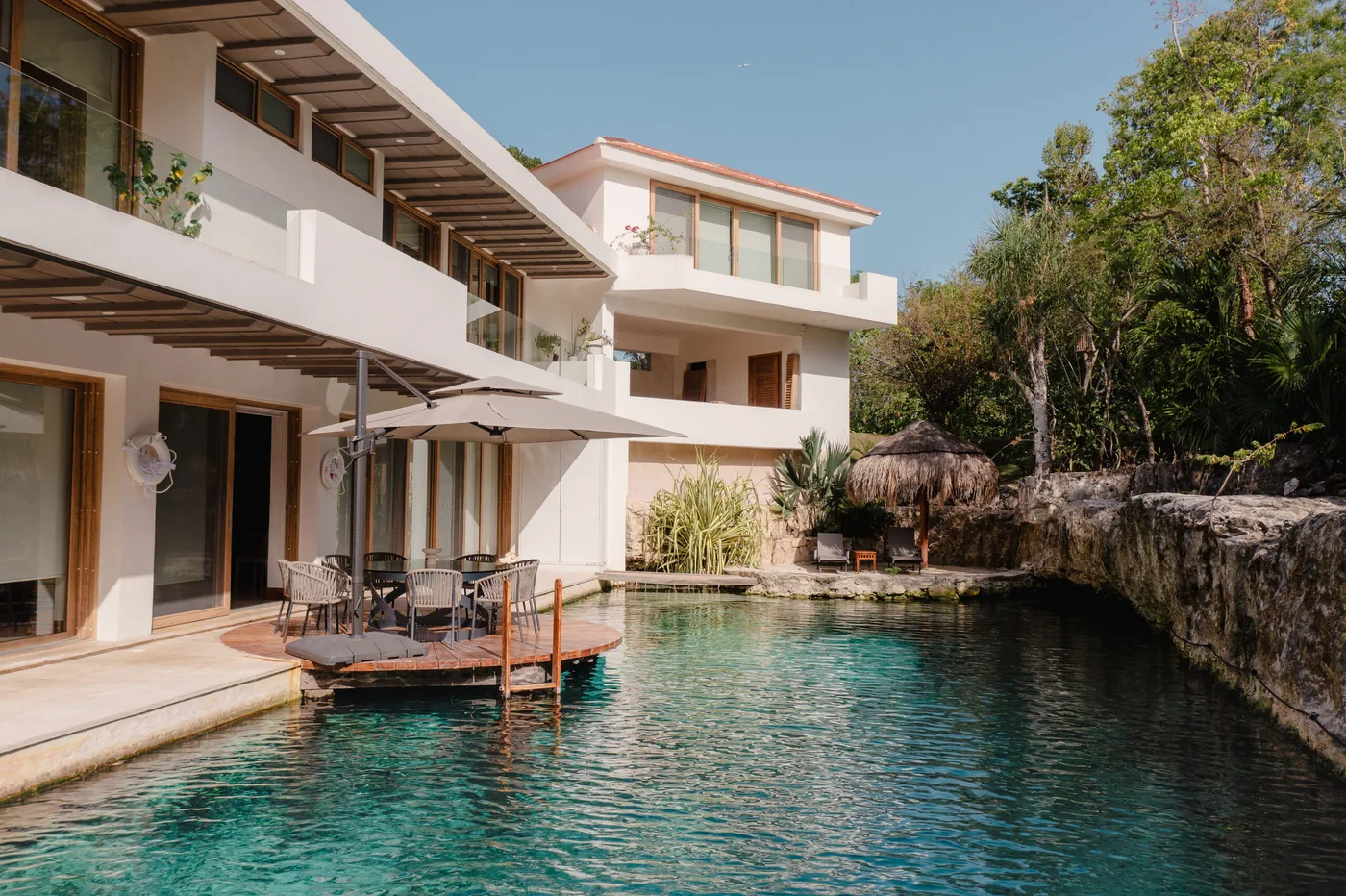
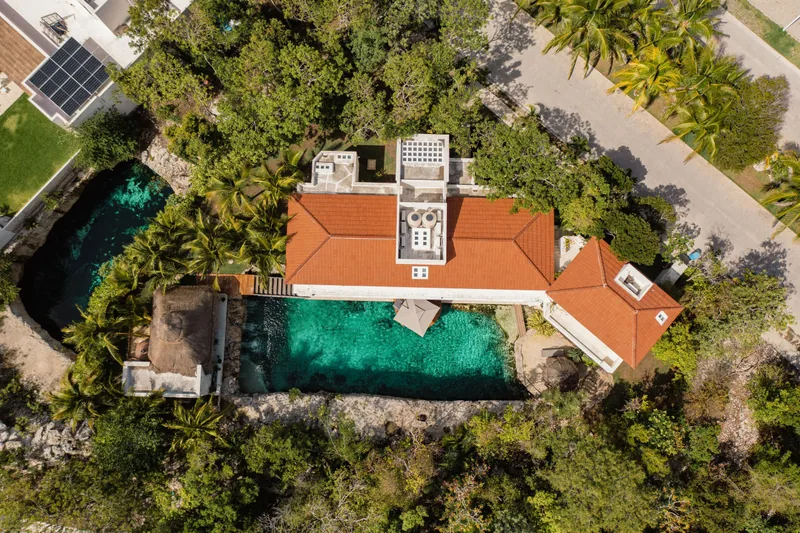
That is the honest case for a private villa in the harder months, and it is why Casa Piedra de Agua works in September as well as it does in February: the cenote is spring-fed, sheltered and unaffected by the weather at the beach.
If you have not swum in one before, here is what to expect. And if you are still deciding where on this coast to base yourself, that is a separate question and we covered it here: Puerto Aventuras vs. Tulum vs. Playa del Carmen.
September, averaging 196.3 mm according to the Mexican national weather service's 1981–2010 normals for Quintana Roo. It is also the statistical peak of hurricane season.
Yes, with the right expectations. Rain typically comes as a short heavy afternoon burst rather than all-day grey. You get an emptier coast in exchange for less predictable afternoons.
June 1 to November 30, with most activity between mid-August and mid-October and a climatological peak around September 10.
Yes. The Caribbean here stays swimmable year-round; winter is about air temperature and wind, not water.
September and October, when some places close and the beaches empty out. They are also the wettest and the riskiest months of the year. That is the whole trade.
For December through April, and especially Christmas, New Year and Easter, months ahead. Availability runs out long before the weather is knowable. For September and October you can often decide late.
The useful question is not when the Riviera Maya is at its best. It is what you want to be true about your week.
If that is certainty (sun on the days you planned for sun), you are looking at winter, and you should be booking now for it. If it is space, quiet and a coast that feels like it belongs to the people who live here, you are looking at the months everyone else avoids, and you should be planning around the weather instead of hoping it cooperates.
Either way the decision gets easier once you stop looking for the perfect month and start asking which compromise you would rather not make.
New to the area? Start with our guide to Puerto Aventuras, or get in touch if you want to talk through dates.