
Riviera Maya
Sargassum in the Riviera Maya: When It Happens and How to Plan Around It
Which months are clearest, why two beaches an hour apart can look completely different on the same morning, and how to plan a trip that barely notices it.
Table of contents
Sargassum is the question most people ask right before booking a Caribbean trip, and the one most travel pages answer badly — either by pretending it does not happen or by making it sound like the coast is unusable for half the year.
Neither is true. Sargassum is a seasonal, predictable phenomenon that varies enormously by month and by beach. Once you know the pattern, it becomes something you plan around rather than something that decides your trip for you.
The Short Answer
- Clearest months
- December through February, with November and March usually close behind.
- Heaviest months
- May through July, with August and September as an inconsistent tail.
- It varies by beach
- Not just by date. Two coastlines an hour apart can look completely different on the same morning.
- Not a reason to cancel
- It is a reason to check conditions close to your dates and to choose accommodation that does not depend entirely on one public beach.
What Sargassum Actually Is
Sargassum is a floating brown seaweed that grows in the open Atlantic and drifts west on ocean currents. It is not pollution and it is not caused by the resorts. In open water it is a functioning ecosystem that shelters fish, turtles and crabs.
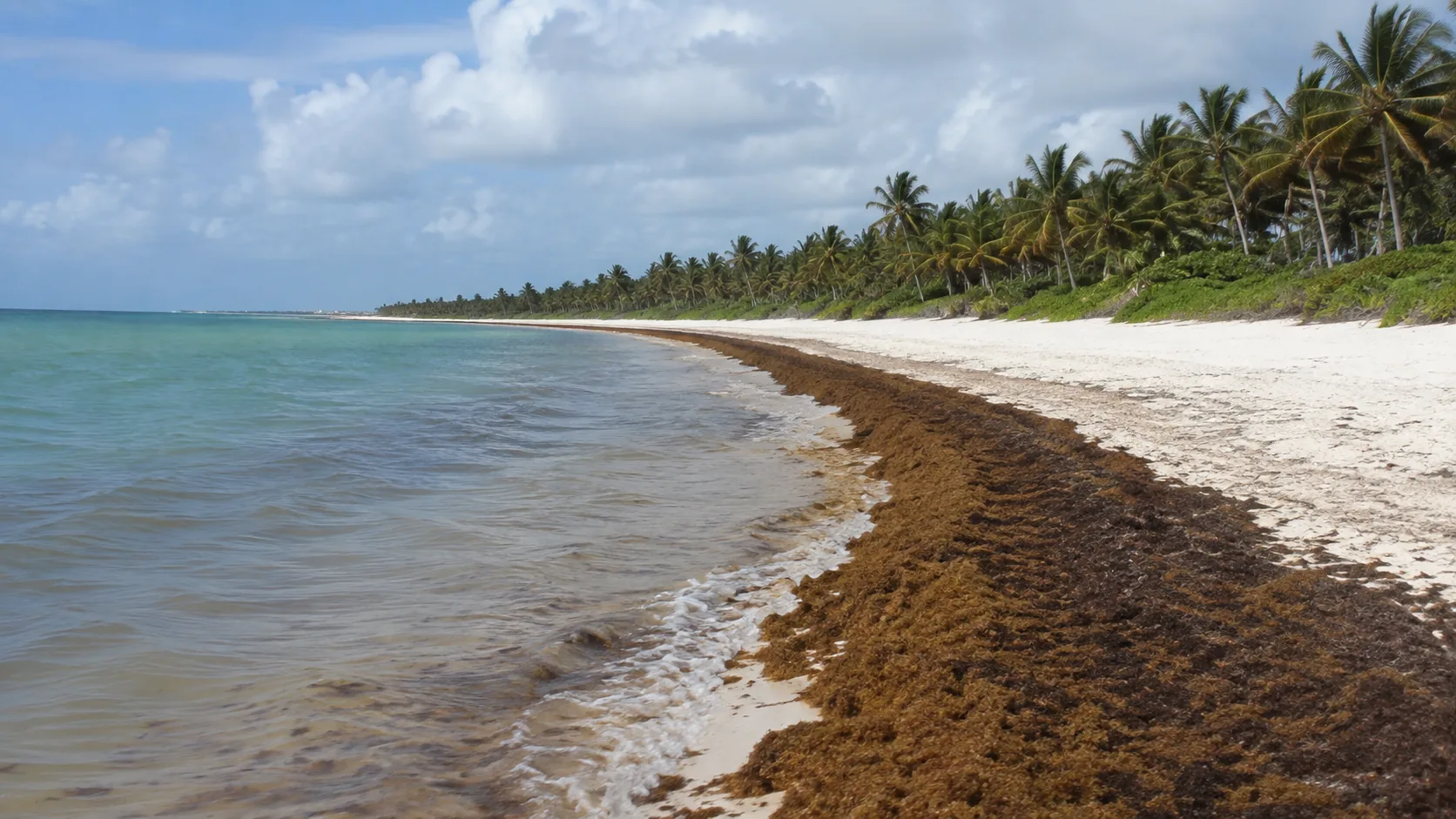
The problem is only what happens when large volumes reach the shore. It piles up, it decomposes, and as it decomposes it smells. That is the part travelers notice.
Volumes have grown substantially since 2011, when the phenomenon began appearing at its current scale. It is now an annual feature of the Mexican Caribbean rather than an anomaly.
When Is Sargassum Season in the Riviera Maya?
The seasonal pattern is consistent year to year, even though the volume changes.
December to February — the clearest window
Sargassum is generally at its lowest and the water at its bluest. This overlaps with the dry season and with peak travel demand, which is not a coincidence.
March and April — the build-up
March is often still favourable. April is when the first significant arrivals show up, particularly on beaches facing east into the open ocean.
May to July — the peak
This is when the Great Atlantic Sargassum Belt is typically at its largest and currents push the most material toward the coast. Volumes can be high, though beach cleaning is also at its most active.
August and September — the inconsistent tail
The end of the heavy season. Some years clear early, others stay heavy into September. This is the hardest stretch to predict.
October and November — the recovery
Conditions tend to improve progressively, with water clarity generally returning through late November.
How Bad Is It This Year?
The University of South Florida’s Optical Oceanography Lab tracks Atlantic sargassum by satellite and publishes a monthly outlook. It is the most reliable public source, and worth checking directly rather than relying on second-hand summaries.
Their outlook expects volumes to keep declining in the following months, possibly through November, with beaching events continuing but less severe than in June and July.
Two things are worth taking from that. The first is that the direction of travel through autumn is favourable. The second is that “record year” headlines are worth checking against the source, because they are frequently a year out of date.
Where Does It Hit Hardest?
This is the part most guides skip, and it matters more than the calendar.
Sargassum arrives on ocean currents, so coastline orientation decides almost everything.
Beaches facing directly east into the open Atlantic catch the most. Sheltered bays, west-facing shores and islands in the current shadow catch far less.
In practice that means beaches along the open Tulum and Akumal stretch tend to be among the most affected, while Isla Mujeres, Cozumel and Holbox are usually far clearer on the same day. Bacalar, being a freshwater lagoon, has none at all.
The practical consequence: a photograph of a seaweed-covered beach somewhere in Quintana Roo tells you very little about the beach you will actually be standing on.
How to Plan Around It
- Travel in the clear window if the beach is the point of the trip. If turquoise water in your photographs is non-negotiable, aim for December to March and book early, because everyone else wants the same weeks.
- Check conditions close to your dates, not months ahead. Daily sargassum trackers and recent photographs from the specific stretch of coast are worth more than any seasonal average. Ask your host — they can see it.
- Do not judge a destination by another season’s photographs. Promotional images are shot in the clearest weeks. So are the alarming ones, in the worst.
- Build a trip that does not depend on one beach. Cenotes, the archaeological sites, Cozumel, Bacalar and the nature parks are all unaffected by what the sea is doing that week. A trip with two or three of those in it is resilient.
- Keep some flexibility. Even in peak season, conditions shift within days. A plan with room to move a beach day is a plan that survives.
What This Means for Where You Stay
Accommodation matters here more than people expect, because it decides how exposed you are.
A stay built entirely around one stretch of public beach has a single point of failure. If that beach has a bad week, the trip has a bad week.
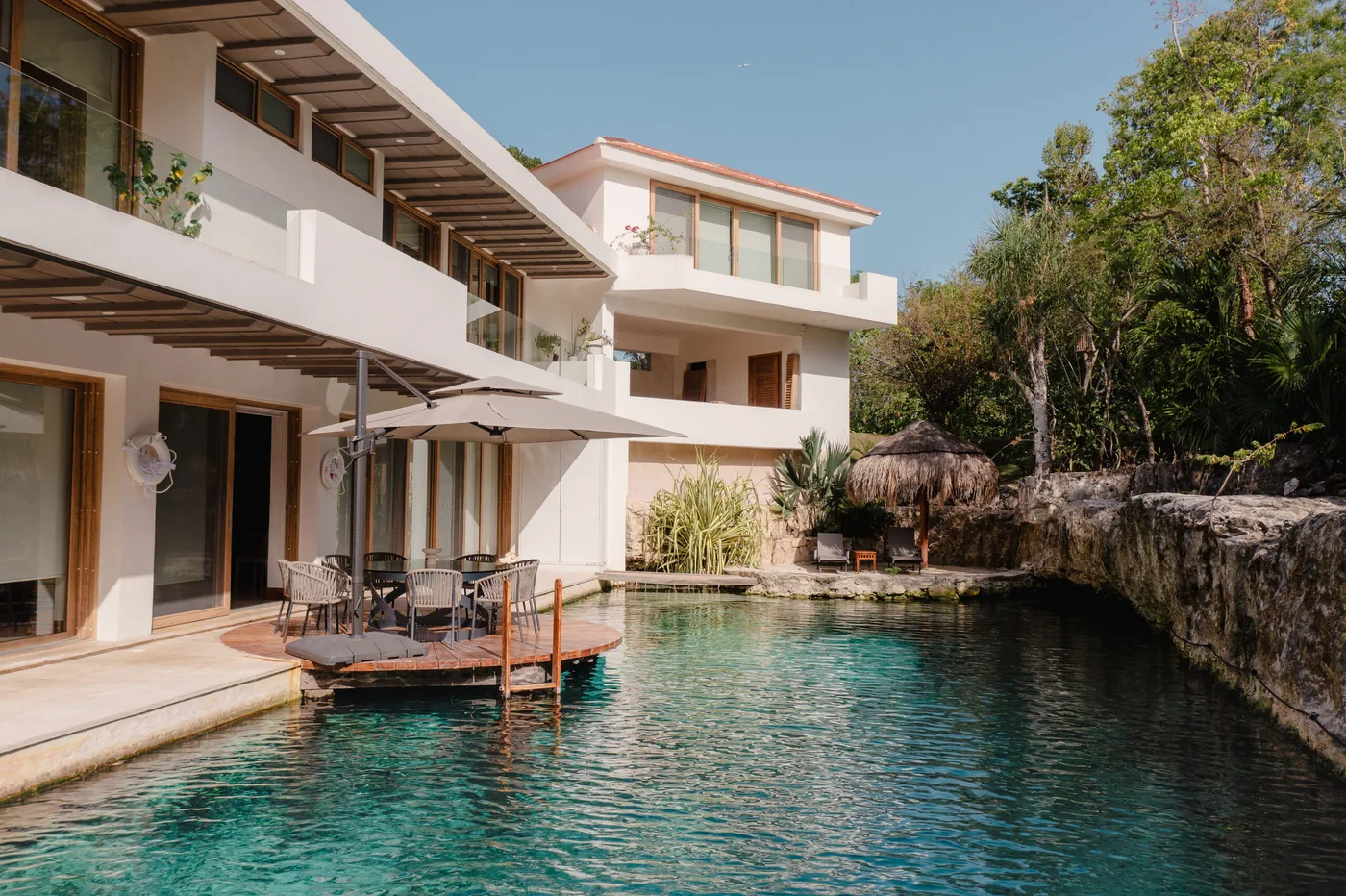
A stay with its own water does not. That is the practical case for a villa with a private cenote: the swimming is not conditional on what the currents did overnight. Cenote water is freshwater, filtered through limestone, and completely unaffected by sargassum.
Casa Piedra de Agua sits in Puerto Aventuras, a gated marina community whose identity has always leaned more toward the water than toward a large public beach scene. Guests can still spend days on the coast when conditions are good — and when they are not, the cenote is a few steps from the door rather than an hour’s drive.
The community also runs organised beach cleaning. Removal in Fátima Bay is coordinated between the residents’ association and the federal authorities responsible for the maritime zone and the national sargassum response, so accumulation on the community’s beach is cleared rather than left to sit.
That is not a claim that sargassum stops mattering. It is a claim that it stops being the thing your week depends on.
Frequently Asked Questions
Is sargassum dangerous?
In the water it is harmless, if unpleasant to swim through. The issue is decomposition on shore: as it breaks down it releases gases that smell strongly and can irritate eyes and airways in large accumulations. Beaches with heavy build-up are usually cleaned quickly for that reason.
Which months have the least sargassum?
December, January and February are the most reliable, with November and March generally close behind.
Do all beaches get it equally?
No, and this is the most useful thing to know. Orientation to the open ocean matters more than location on a map. Sheltered and west-facing shores, and islands like Cozumel and Isla Mujeres, are consistently clearer than east-facing open coast.
Can I still swim during sargassum season?
Along the coast, it depends on the day and the beach. Cenotes, on the other hand, are unaffected year-round, which is why they become the reliable option in the heavy months.
Should I cancel a trip because of sargassum?
Rarely. Adjusting expectations, checking conditions before you go and building a trip that is not entirely beach-dependent solves the problem for most travelers.
Planning Around the Season
Sargassum is a real, seasonal condition, not a reason to avoid the Mexican Caribbean. It has a pattern, it varies hugely by beach, and it is entirely possible to plan a trip that barely notices it.
The travelers who have the worst time are the ones who arrive expecting the photographs. The ones who have the best time are the ones who checked, chose their weeks, and had somewhere to swim regardless.